
Creator OS: Build Your Mini Media Company
Creator OS Revealed: The Ultimate Guide to Building a Mini Media Company The Era of the Influencer is Dead. Welcome to the Creator OS. Picture this: you are standing on the floor ...
Creator OS Revealed: The Ultimate Guide to Building a Mini Media Company
The Era of the Influencer is Dead. Welcome to the Creator OS.
Picture this: you are standing on the floor of the biggest creator industry event of the year. You look around, expecting to hear conversations about brand deal negotiations, TikTok algorithms, or the latest viral dance trends. Instead, the top players are discussing something entirely different. They are talking about their Creator OS, their custom tech stacks, enterprise valuations, and direct-to-consumer commerce strategies.
What exactly is happening? The ecosystem has matured. Top-tier creators are no longer positioning themselves as mere “influencers” waiting for a brand to sponsor their next video. Instead, they are aggressively evolving into highly profitable, independent mini media companies. They are building proprietary products, launching gated communities, owning their distribution channels, and driving massive commerce. In this comprehensive guide, we are going to tear down the mechanics of the Creator OS, explain why this shift is vital for your survival, and show you exactly how to build your own media empire from scratch.
What is a Creator OS?
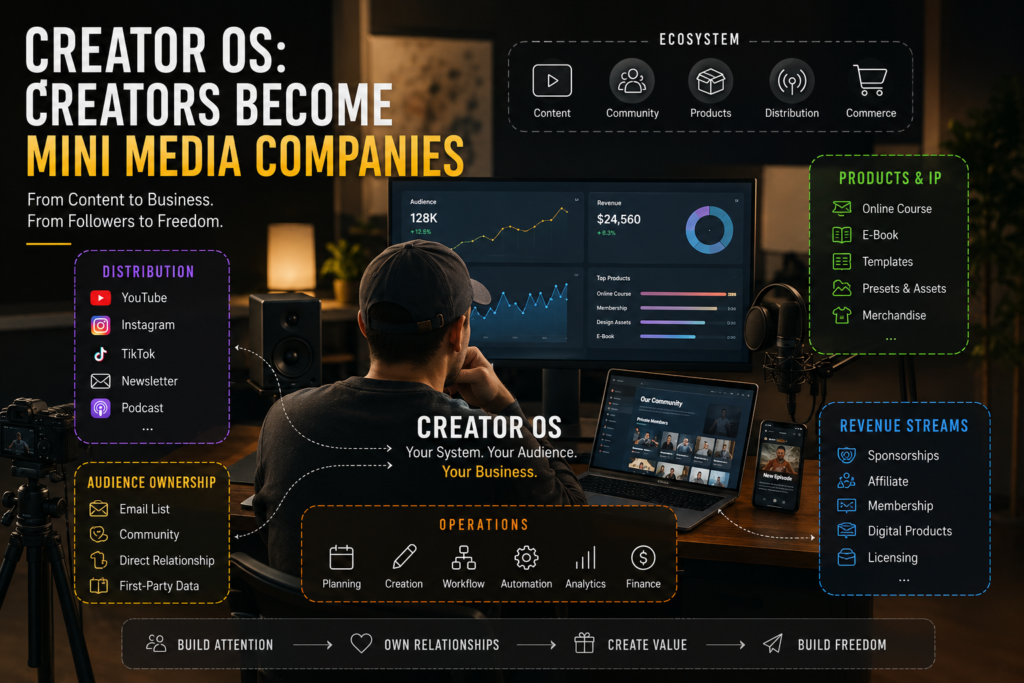
At its core, a Creator OS (Operating System) is the underlying framework that transforms a solo content creator into a scalable media business. It is a combination of your mindset, your technological stack, your standardized operating procedures (SOPs), and your business model.
Before the widespread adoption of the Creator OS, the business model of an influencer was dangerously simple: build an audience on a rented platform (like YouTube or Instagram) and sell the attention of that audience to advertisers. It was a single point of failure. If the algorithm changed, or if a platform decided to ban an account, the entire business would collapse overnight.
The Creator OS changes this dynamic completely. By implementing a Creator OS, you build a diversified ecosystem. You are no longer renting your audience; you are owning the relationship. You are not just creating content; you are building an asset.
The Shift: From Influencer to Media Business
The fundamental difference between an influencer and a mini media company lies in equity and control. An influencer relies entirely on external validation—algorithm pushes, sponsor budgets, and platform trends. A mini media company built on a solid Creator OS dictates its own terms. It has recurring revenue streams, a loyal customer base, and diversified assets that can eventually be sold or scaled independently of the creator’s personal brand.
Creator economy market projections
The Four Pillars of the Creator OS
To successfully transition into a mini media company, your Creator OS must be built upon four unshakeable pillars.
1. Owned Distribution
Relying solely on social media algorithms is a recipe for anxiety and burnout. The first pillar of a robust Creator OS is owned distribution. This means capturing your audience’s contact information so you can reach them directly, at any time, without a middleman.
Newsletters and SMS marketing are the gold standards here. When you publish a newsletter, it lands directly in your reader’s inbox. There is no algorithm deciding whether or not your audience gets to see your content. Your Creator OS should seamlessly funnel attention from discovery platforms (like short-form video) into your owned distribution channels.
2. Hyper-Engaged Communities
Audience members consume your content passively; community members interact with you and, more importantly, with each other. The modern Creator OS heavily emphasizes community building.
Creators are migrating their most loyal followers into private ecosystems using platforms like Discord, Skool, or Circle. Inside these gated communities, creators can host exclusive Q&A sessions, provide deeper educational value, and foster networking. This creates a powerful moat around your business. When people feel a sense of belonging, they do not leave.
3. Proprietary Products
Sponsorships are great for cash flow, but products build true wealth. Your Creator OS must facilitate the creation and distribution of your own products.
This could be digital products like online courses, templates, and software tools, or physical products like specialized merchandise, consumer packaged goods (CPG), or apparel. By selling your own products, you capture 100% of the profit margin and retain the customer data for future launches.
4. Direct Commerce & Subscriptions
The final pillar is the commerce engine. A mini media company does not wait for a brand to send a check. Instead, they implement recurring revenue models.
Whether it is a paid premium newsletter, a membership community, or a monthly physical product subscription, recurring revenue stabilizes your business. Your Creator OS tracks churn rates, lifetime value (LTV), and customer acquisition costs (CAC)—metrics that traditional businesses have used for decades, now applied to the creator economy.
How to launch your first digital product
How to Build Your Personal Creator OS
Transitioning to this new model requires a systematic approach. You cannot simply flip a switch and become a media company. Here is the step-by-step blueprint to designing your personal Creator OS.
Step 1: Audit and Realign Your Funnel
Start by mapping out your current audience flow. A successful Creator OS uses a structured “Top, Middle, Bottom” funnel strategy.
- Top of Funnel (Discovery): TikTok, Instagram Reels, YouTube Shorts, X (Twitter). This is where you grab attention.
- Middle of Funnel (Nurture): Long-form YouTube videos, podcasts, deep-dive blog posts. This is where you build trust and showcase authority.
- Bottom of Funnel (Conversion): Your email list, private community, and sales pages. This is where the transaction happens.
Ensure that every piece of top-of-funnel content clearly directs the viewer to the middle and bottom of the funnel.
Step 2: Establish Your Tech Stack
A mini media company requires enterprise-grade tools, scaled down for small teams. Your Creator OS tech stack should include:
- Content Management: Notion, Airtable, or Trello for editorial calendars and idea pipelines.
- Email Marketing: ConvertKit (now Kit), Beehiiv, or Substack to manage your owned audience.
- Community Hosting: Circle, Skool, or a well-organized Discord server.
- Commerce & Checkouts: Stripe, Shopify, or Lemon Squeezy to handle transactions smoothly.
- Analytics: Robust dashboards that track not just views, but conversion rates and revenue per subscriber.
Step 3: Scale Your Team (The Micro-Agency Model)
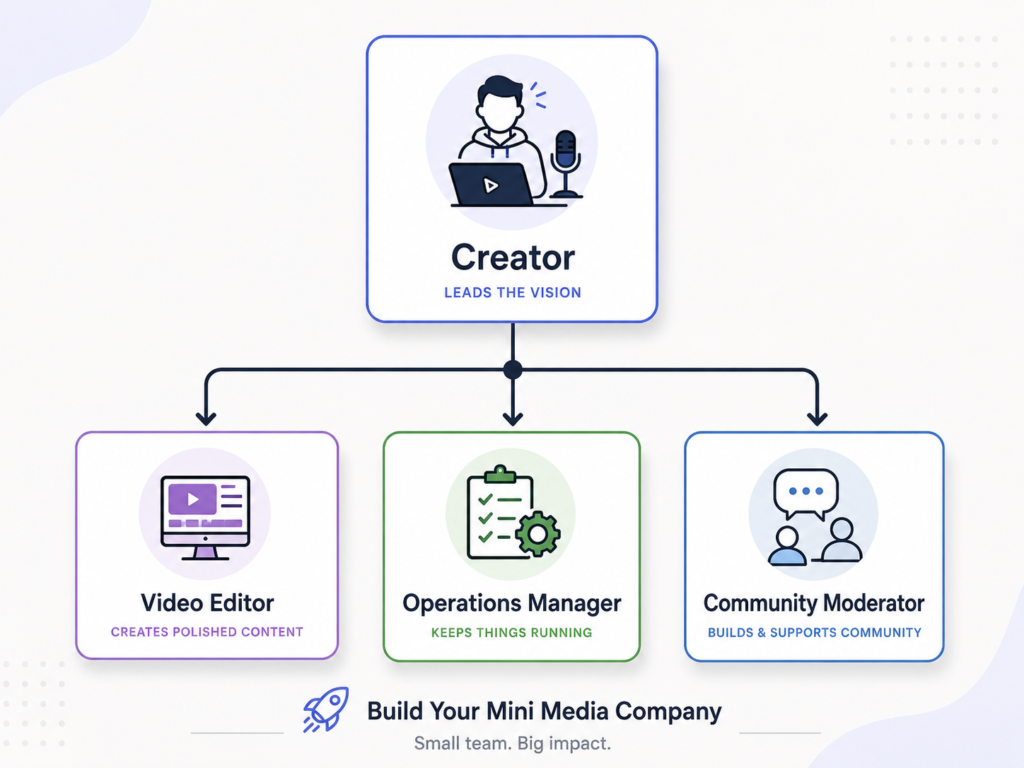
You cannot do this alone. The biggest mistake creators make is holding onto every task until they burn out. To build a true Creator OS, you must step into the role of CEO and start delegating.
You do not need a massive corporate staff. Start by hiring fractional talent or freelancers. A standard mini media company team structure often looks like this:
- The Creator (You): Focuses solely on ideation, on-camera performance, and high-level strategy.
- The Operator/Integrator: Manages the Creator OS, handles the tech stack, and ensures deadlines are met.
- The Editor: Cuts the videos and repurposes content for multiple platforms.
- The Writer/Researcher: Helps script videos and drafts the weekly newsletter.
By building this team, your Creator OS can run smoothly even if you take a week off.
The Psychological Shift: Thinking Like a Media Executive
Implementing a Creator OS requires a profound psychological shift. It is easy to get addicted to the dopamine of going viral. But viral views do not always equate to a sustainable business.
When you start treating your platform as a mini media company, you start prioritizing systems over sporadic virality. You begin to ask different questions. Instead of asking, “How can I get a million views on this next video?” you ask, “How can I acquire 1,000 highly qualified email subscribers this week?”
Neutral observation: Creators who refuse to make this mindset shift often face severe burnout. The algorithm is a cruel boss. It demands constant, escalating output. By contrast, a Creator OS provides a safety net. If a video tanks, your business does not suffer, because your recurring revenue and community subscriptions are holding the foundation strong.
Future-Proofing: AI and the Creator OS
As we navigate deeper into 2026, Artificial Intelligence has become intrinsically woven into the fabric of every successful Creator OS. Mini media companies are using AI not to replace the creator’s unique voice, but to supercharge the backend operations.
AI tools are being used to automatically generate show notes, slice long-form content into dozens of short-form clips, analyze community sentiment, and even predict which product lines will sell best based on audience data. Integrating AI into your Creator OS is no longer optional; it is the leverage you need to compete with much larger, traditional media conglomerates.
Conclusion: Your Empire Awaits
The transition from a reactive influencer to a proactive mini media company is the most critical evolution in the digital landscape today. The creators who understand and implement a robust Creator OS are the ones who will thrive, build generational wealth, and maintain their sanity in a hyper-competitive market.
Stop renting your audience. Stop relying solely on the algorithm. Start building your products, nurturing your community, owning your distribution, and driving your own commerce. The tools are available, the blueprint is clear, and the opportunity is massive. It is time to install your Creator OS and launch your mini media company.
Frequently Asked Questions (FAQ)
1. What exactly is a Creator OS?
It is the overarching system—comprising strategy, software tools, team structures, and monetization frameworks—that transforms an individual content creator into a scalable, independent mini media company.
2. Do I need a massive audience to implement a Creator OS?
Absolutely not. In fact, building your Creator OS early is highly recommended. Even with just 1,000 true fans, having a system to capture emails, offer products, and build a community can generate significant, sustainable income.
3. How much does it cost to build a tech stack for a mini media company?
You can start incredibly lean. Many newsletter and community platforms offer free tiers for beginners. As your revenue grows, you can reinvest into premium tools. Expect to spend anywhere from $50 to $300 a month on the core software when scaling.
4. Is the traditional influencer sponsorship model completely dead?
Not dead, but it is no longer the main event. Smart media companies still take sponsorships, but they treat them as a bonus revenue stream rather than their sole financial lifeline. The Creator OS prioritizes owned revenue over rented revenue.
Related articles

Why AI Aesthetics Are Boring Audiences: The Proven Secret to Anti-AI Design
Let's be brutally honest for a moment. Have you scrolled through your social media feed lately and felt… absolutely nothing? Yo...

7 Web Design tool Being Shaped by AI in 2026
7 Web Design tool Being Shaped by AI in 2026: Proven Secrets to Autonomous Execution Are you still wasting hours downloading AI-g...